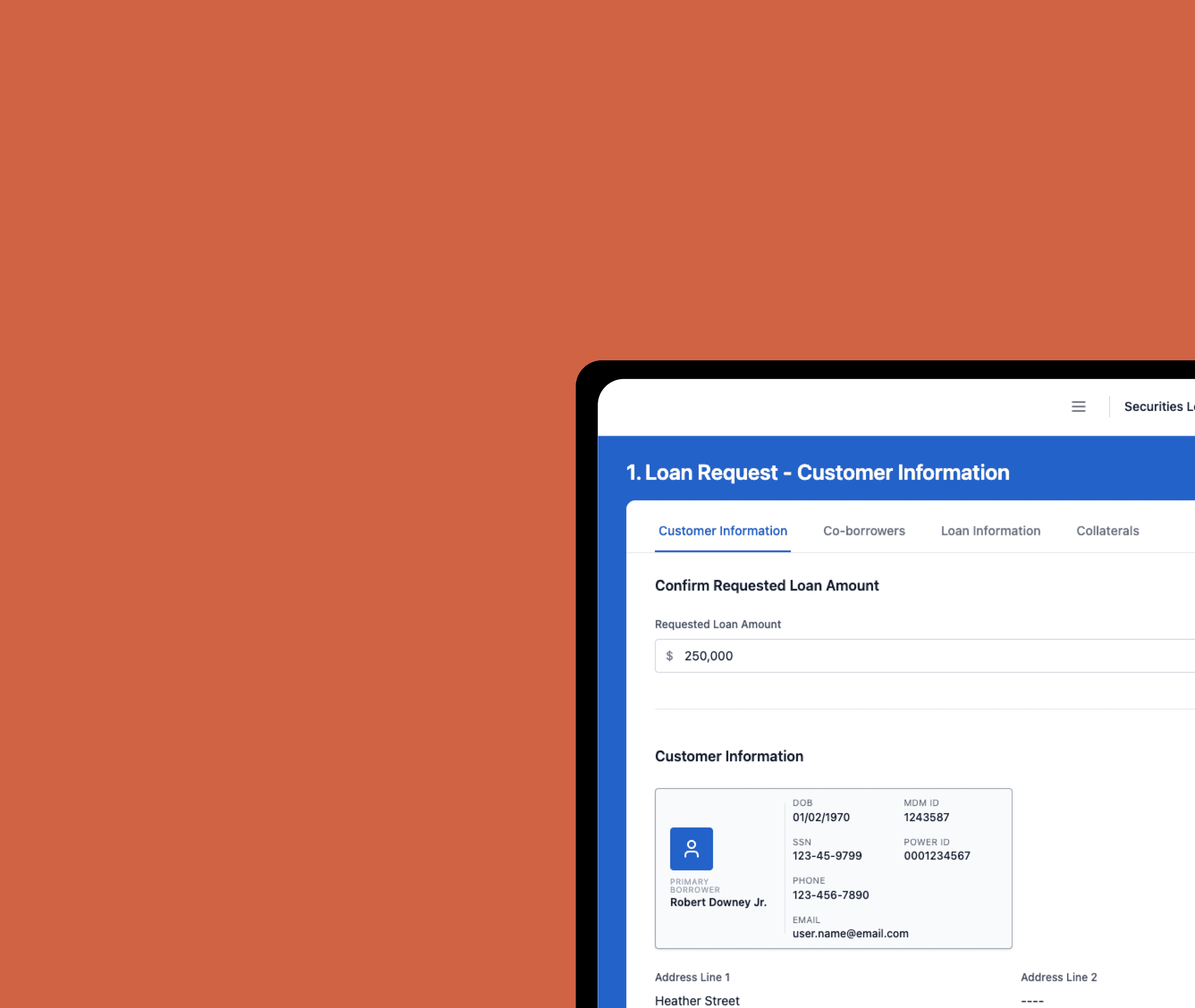
Designing web application tools for relationship bankers submitting securities-based loans on behalf of high net worth clients.
Designing web application tools for relationship bankers submitting securities-based loans on behalf of high net worth clients.
Designing web application tools for relationship bankers submitting securities-based loans on behalf of high net worth clients.
Click through to explore key flows. This is a non-production, portfolio-only prototype built for NDA-compliant review, with no backend or data storage. All content is anonymized and uses dummy data only. Because of NDA obligations,
I can’t share raw Figma Files, but I’m happy to walk you through the system live and answer anything in detail. View NDA Document
View the Full Figma Deck
Responsible for end-to-end design, collaborating with product, engineering, and research for a cohesive user experience.
Client: PNC Bank
Role: Lead Product Designer
Platform: Web Application
Timeline: July 2025 – December 2025
Responsible for end-to-end design, collaborating with product, engineering, and research for a cohesive user experience of a centralized loan lending system.
Role: UX Designer
Client: PNC Bank via Cognizant
Timeline: 07/25 - 12/25
Tools / Stack : Figma, HTML, CSS, Javascript, Excel, MS Office
Problem:
Bankers were forced to jump between disconnected systems to evaluate and complete a single loan application, creating slow, error-prone decisions for high-net-worth clients and heavy delivery complexity for engineering.

What were the success metrics?
Product success was defined around operational outcomes, not UI adoption. The primary success metrics were reduced time to evaluate and submit a securities-based lending application, fewer systems touched per task, and lower operational cost per loan. We also looked at banker confidence as a qualitative signal, because decision hesitation in lending is a proxy for risk. If bankers could move faster without increasing errors or rework, the product was doing its job.
Time
it takes to complete a single securities based loan application
Efficiency
of the product rollout and banker workflow
Operational Cost
per application (average)
Situation:
47 min
average time to complete
a loan application
5 systems
bankers switched between
per case
$420
avg. operational cost
per application
What I did:
I joined the project at the earliest stage to untangle this fragmented workflow, introducing functional prototypes to align product and engineering around a unified solution and accelerate platform rollout.
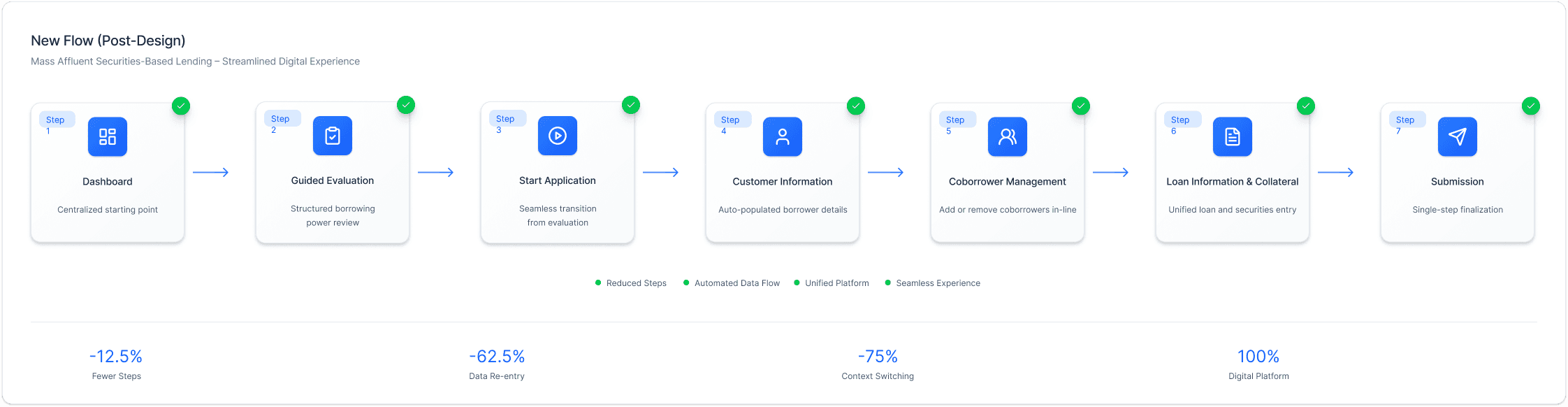
How did I move from problem definition to solution?
Once the problem was clearly framed, I designed a simplified future-state flow that reduced steps and centralized decision-critical information. Low-fidelity flows and prototypes were used to validate logic and sequencing before moving into detailed interface design. This ensured the solution addressed the root problem rather than symptoms.
How did constraints shape the design process?
Regulatory, technical, and legacy system constraints were treated as design inputs, not blockers. Understanding these constraints early allowed me to design solutions that were feasible within the existing ecosystem. This prevented late-stage rework and ensured the final design could realistically be implemented and scaled.
How did this product fit into PNC’s broader platform strategy?
The solution was designed as a unifying layer rather than a standalone tool. It aligned with existing systems and compliance requirements while reducing reliance on manual workarounds like spreadsheets and cross-tool lookups. From a product standpoint, this made the experience easier to extend to adjacent lending products without creating one-off workflows that would increase long-term maintenance and technical debt.
How did I turn ambiguity into a clear product direction?
Ambiguity was addressed by translating high-level business goals into concrete user flows. I visualized current-state processes, identified failure points, and proposed a simplified future-state flow that stakeholders could react to. Early prototypes were used as alignment tools, allowing teams to converge quickly on a shared direction.
What happened:
27 min
average time to complete
a loan application
1-2 systems
bankers switched between
per case
$344
avg. operational cost
per application
What I delivered:
I helped design a set of core evaluation tools including dynamic dashboard search and filtering, co-borrower management, real-time borrowing power calculations, unified borrower profiles, multi-collateral management, streamlined underwriter decision handling, and acknowledgment workflows.