
Helping Patients Remember Visits
Carry proposes a patient companion for oncology surveillance, helping people capture and revisit important visit conversations. The goal is to reduce information loss, clarify next steps and support patients between testing cycles with clarity and confidence.
My Role
Product Designer
Team
UX Designer (me), Senior Designer, Engineer, PM
Stack
Figma, Claude, Gemini, Miro, UX Thinking, Figma Make
Company
Natera
Industry
Biotechnology
Timeline
2 weeks
Introduction
Oncology patients often leave appointments remembering the main result but forgetting important details about symptoms, follow-ups, and next steps. Working with a small product team, I helped turn that problem into a clear patient journey.
We proposed Carry, a simple and consent-based companion that lets patients revisit important conversations without replacing their care team. I helped design the core experience, prototype, and presentation that brought the MVP concept to life.
Interact with the prototype below. Just click through, login is simulated.

Cancer patients recall only 23.2% of information from their visits.
Patients may remember the main result while losing important details once they return home.
Information overload: Patients must process complex clinical guidance while managing fear and uncertainty.
Fragmented tools: Results, recordings, notes, and reminders live across disconnected systems.
Lost follow-through: Symptoms, timelines, and next steps become harder to recall and act on after the visit.

How would improving information recall for patients provide business value?
I used an illustrative before-and-after model to connect the patient recall problem to potential business value. The hypothesis was that helping patients revisit key details and next steps could improve follow-through across a recurring surveillance journey.
Improve comprehension: Captured conversations and organized details could help patients better understand what was discussed.
Strengthen follow-through: Clearer next steps and reminders could reduce missed actions between visits.
Support long-term continuity: Better recall and follow-up could help patients stay engaged across repeated testing cycles.
At Natera’s scale, even modest improvements in comprehension and follow-through could create meaningful value across hundreds of thousands of patients. The figures shown are hypothetical and intended to demonstrate the opportunity, not measured product outcomes.

Patients use multiple tools to accomplish a single task
These issues were not caused by a lack of tools, but by a lack of continuity between them. Existing products captured isolated parts of the experience, such as results, recordings, notes, or reminders, without connecting the care conversation to what patients needed to understand and do next.
I identified an opportunity for a focused companion that could bring those fragments together across the surveillance cycle while supporting, rather than replacing, the patient’s care team.

Aligning Research, Product, and Engineering
I owned the interface design, user flows, and MVP presentation visuals while working with two senior designers, a product manager, and an engineer.
Research: I helped organize findings and turn them into product opportunities.
Strategy: I aligned with product on priorities and MVP scope.
Feasibility: I worked with engineering to refine interactions and account for constraints.
This collaboration helped me balance patient needs, business goals, and technical realities while delivering a clear MVP proposal.

Connecting the Oncology Visit Experience
The core problem was not a lack of information, but fragmentation across the oncology visit experience. As I mapped the journey, three opportunities became clear:
Information was scattered: Results, notes, recordings, and reminders lived across disconnected tools.
The conversation was missing: Patients lacked a bridge between what was said and what they needed to understand or do next.
Continuity mattered most: Support needed to extend before, during, and after each visit as one connected experience.

I want to ensure usefulness, trust, and feasibility
Defining the MVP required more than choosing features. I evaluated patient consent, clinical safety, AI transparency, and the three-week timeline together so the product could support meaningful recall without replacing clinicians, obscuring AI decisions, or expanding beyond what the team could responsibly deliver.

Structuring the work from strategy to handoff
To start designing a system, I organized the Figma file as a shared product workspace rather than a collection of disconnected screens. Product requirements, strategy, system decisions, interface design, and handoff documentation were separated into clear sections so each partner could quickly understand the work at the level they needed.
Requirements stayed connected to design: The PRD, story overview, flows, and edge cases remained visible beside the evolving solution.
Strategy guided execution: Constraints, architecture, and product decisions were documented before moving into high-fidelity design.
Handoff was built into the process: Reusable components, final screens, annotations, and structured implementation notes gave engineering a clearer path to build.
This setup helped product, design, and engineering work from the same source of truth, reduced ambiguity between phases, and made the final proposal easier to review, present, and continue developing.

Mapping constraints before designing
Before moving into interface design, I mapped the constraints that could shape the product, create risk, or limit what the team could responsibly deliver. This helped separate essential safeguards from optional features and gave the team a clearer basis for prioritization.
Consent and privacy: Recording healthcare conversations required clear patient control and awareness of legal and privacy considerations. I planned to address this through explicit consent states, transparent recording controls, and clear ownership of uploaded content.
Clinical safety: The product could support recall, but it could not replace a clinician or present uncertain information as medical guidance. I planned to use source-linked evidence, editable outputs, and visible escalation paths back to the care team.
AI reliability: Transcripts and generated takeaways could be incomplete or incorrect. I planned to make AI-supported content traceable, reviewable, and easy for patients to correct before relying on it.
Three-week scope: The sprint could not support every feature across the surveillance journey. I planned to prioritize the smallest complete flow across preparation, capture, review, and follow-up.
Mapping these constraints early helped turn risk into design criteria. Instead of treating them as late-stage blockers, I used them to define the MVP, guide interaction decisions, and keep the proposal useful, safe, and feasible.
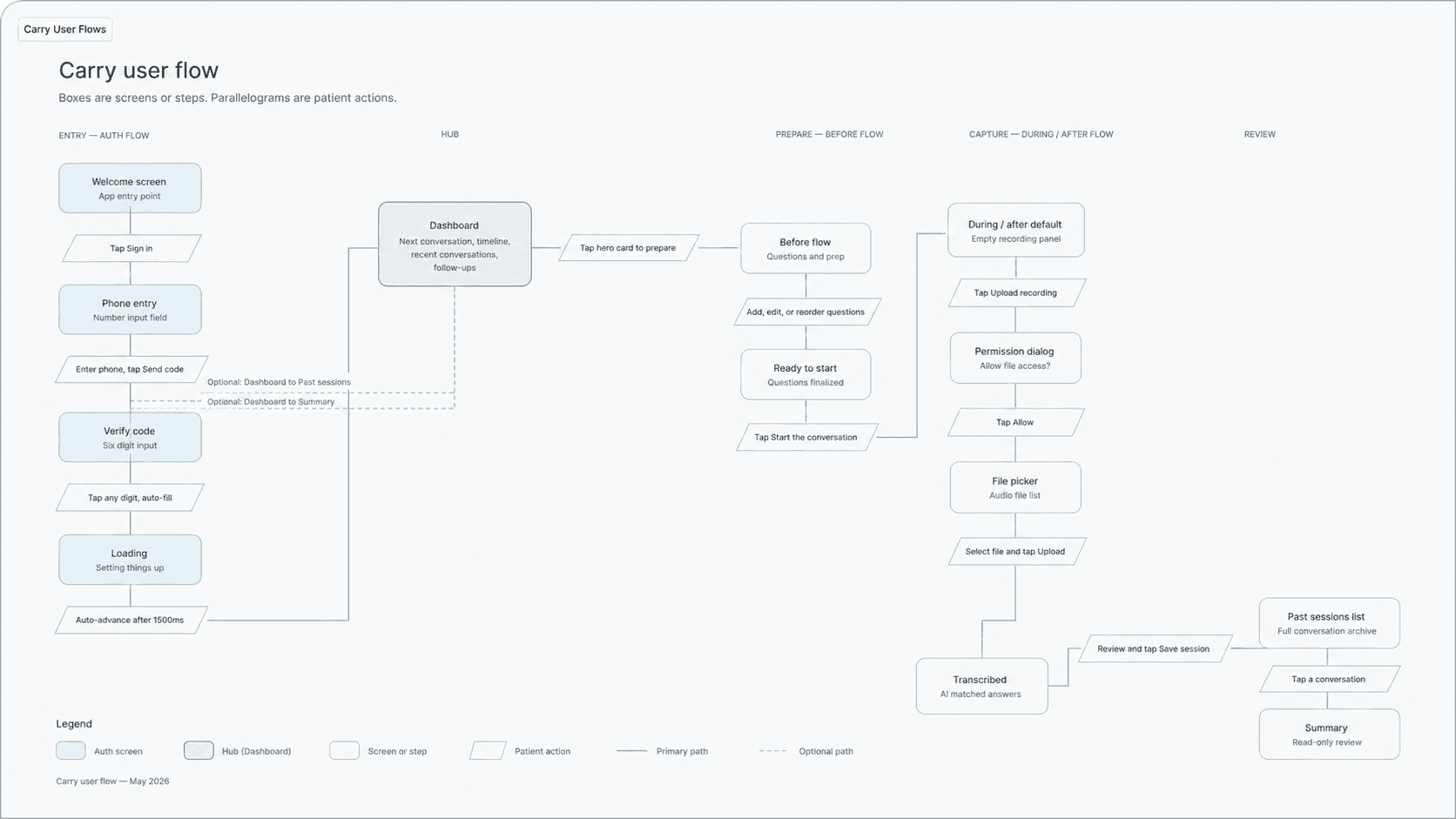
Mobile first design and user flows
I chose to prototype Carry as an iPhone experience because patients are far more likely to bring a phone into an oncology visit than a laptop. That decision grounded the concept in the patient’s real environment and let me focus on a lightweight flow that could support preparation, capture, review, and follow-up from one familiar device.
Start with the patient’s context: The experience needed to work in the clinic, at home, and between appointments.
Reduce interaction effort: I prioritized simple actions, clear transitions, and minimal setup during high-stress moments.
Connect the full journey: I mapped authentication, visit preparation, recording upload, transcription, saved sessions, and review as one continuous system.
The resulting flow gave the team a shared view of the MVP, clarified primary and optional paths, and translated the strategy into a structure ready for interface design and prototyping.
Let's create impactful designs together!
Let's create impactful designs together!
If you're on the lookout for a dedicated and impassioned digital designer to breathe life into your vision, your search ends here. Let's unite to craft unforgettable experiences that resonate deeply, leaving an enduring mark.
Helping Patients Remember Visits
Carry proposes a patient companion for oncology surveillance, helping people capture and revisit important visit conversations. The goal is to reduce information loss, clarify next steps and support patients between testing cycles with clarity and confidence.
Helping Patients Remember Visits
Carry proposes a patient companion for oncology surveillance, helping people capture and revisit important visit conversations. The goal is to reduce information loss, clarify next steps and support patients between testing cycles with clarity and confidence.
My Role
Product Designer
Team
UX Designer (me), Senior Designer, Engineer, PM
Stack
Figma, Claude, Gemini, Miro, UX Thinking, Figma Make
Company
Natera
Industry
Biotechnology
Timeline
2 weeks
Introduction
Oncology patients often leave appointments remembering the main result but forgetting important details about symptoms, follow-ups, and next steps. Working with a small product team, I helped turn that problem into a clear patient journey.
We proposed Carry, a simple and consent-based companion that lets patients revisit important conversations without replacing their care team. I helped design the core experience, prototype, and presentation that brought the MVP concept to life.
Interact with the prototype below. Just click through, login is simulated.
Cancer patients recall only 23.2% of information from their visits.
Oncology surveillance visits compress test results, risk, follow-up guidance, and emotional stress into a short conversation. Patients may remember the main result, while losing crucial details about symptoms, timelines, and next steps once they return home.
How would improving information recall for patients provide business value?
Oncology surveillance visits compress test results, risk, follow-up guidance, and emotional stress into a short conversation. Patients may remember the main result, while losing crucial details about symptoms, timelines, and next steps once they return home.
Patients use multiple tools to accomplish a single task
These issues were not caused by a lack of tools, but by a lack of continuity between them. Existing products captured isolated parts of the experience, such as results, recordings, notes, or reminders, without connecting the care conversation to what patients needed to understand and do next.
I identified an opportunity for a focused companion that could bring those fragments together across the surveillance cycle while supporting, rather than replacing, the patient’s care team.
Aligning Research, Product, and Engineering
I owned the interface design, user flows, and MVP presentation visuals while working with two senior designers, a product manager, and an engineer.
Research: I helped organize findings and turn them into product opportunities.
Strategy: I aligned with product on priorities and MVP scope.
Feasibility: I worked with engineering to refine interactions and account for constraints.
This collaboration helped me balance patient needs, business goals, and technical realities while delivering a clear MVP proposal.
Connecting the Oncology Visit Experience
The core problem was not a lack of information, but fragmentation across the oncology visit experience. As I mapped the journey, three opportunities became clear:
Information was scattered: Results, notes, recordings, and reminders lived across disconnected tools.
The conversation was missing: Patients lacked a bridge between what was said and what they needed to understand or do next.
Continuity mattered most: Support needed to extend before, during, and after each visit as one connected experience.
I want to ensure usefulness, trust, and feasibility
Defining the MVP required more than choosing features. I evaluated patient consent, clinical safety, AI transparency, and the three-week timeline together so the product could support meaningful recall without replacing clinicians, obscuring AI decisions, or expanding beyond what the team could responsibly deliver.
Structuring the work from strategy to handoff
To start designing a system, I organized the Figma file as a shared product workspace rather than a collection of disconnected screens. Product requirements, strategy, system decisions, interface design, and handoff documentation were separated into clear sections so each partner could quickly understand the work at the level they needed.
Requirements stayed connected to design: The PRD, story overview, flows, and edge cases remained visible beside the evolving solution.
Strategy guided execution: Constraints, architecture, and product decisions were documented before moving into high-fidelity design.
Handoff was built into the process: Reusable components, final screens, annotations, and structured implementation notes gave engineering a clearer path to build.
This setup helped product, design, and engineering work from the same source of truth, reduced ambiguity between phases, and made the final proposal easier to review, present, and continue developing.
Mapping constraints before designing
Before moving into interface design, I mapped the constraints that could shape the product, create risk, or limit what the team could responsibly deliver. This helped separate essential safeguards from optional features and gave the team a clearer basis for prioritization.
Consent and privacy: Recording healthcare conversations required clear patient control and awareness of legal and privacy considerations. I planned to address this through explicit consent states, transparent recording controls, and clear ownership of uploaded content.
Clinical safety: The product could support recall, but it could not replace a clinician or present uncertain information as medical guidance. I planned to use source-linked evidence, editable outputs, and visible escalation paths back to the care team.
AI reliability: Transcripts and generated takeaways could be incomplete or incorrect. I planned to make AI-supported content traceable, reviewable, and easy for patients to correct before relying on it.
Three-week scope: The sprint could not support every feature across the surveillance journey. I planned to prioritize the smallest complete flow across preparation, capture, review, and follow-up.
Mapping these constraints early helped turn risk into design criteria. Instead of treating them as late-stage blockers, I used them to define the MVP, guide interaction decisions, and keep the proposal useful, safe, and feasible.
Mobile first design and user flows
I chose to prototype Carry as an iPhone experience because patients are far more likely to bring a phone into an oncology visit than a laptop. That decision grounded the concept in the patient’s real environment and let me focus on a lightweight flow that could support preparation, capture, review, and follow-up from one familiar device.
Start with the patient’s context: The experience needed to work in the clinic, at home, and between appointments.
Reduce interaction effort: I prioritized simple actions, clear transitions, and minimal setup during high-stress moments.
Connect the full journey: I mapped authentication, visit preparation, recording upload, transcription, saved sessions, and review as one continuous system.
The resulting flow gave the team a shared view of the MVP, clarified primary and optional paths, and translated the strategy into a structure ready for interface design and prototyping.
Helping Patients Remember Visits
Carry proposes a patient companion for oncology surveillance, helping people capture and revisit important visit conversations. The goal is to reduce information loss, clarify next steps and support patients between testing cycles with clarity and confidence.